Showing posts with label Poem. Show all posts

Friday, 30 January 2015

Poem for a Winter night


My poem for the day is by Dorothy Wordsworth (1771 - 1855), William's sister.  It evokes beautifully what it's like to be awake on a winter's night with a small child who won't go to sleep.
The sunset was beautiful this evening, golden and dramatic, it really was nature's paintbrush sweeping across the sky. I hope you like the poem.

The Cottager to her Infant


The days are cold, the nights are long,
The North wind sings a doleful song;
Then hush again upon my breast;
All merry things are now at rest,
Save thee, my pretty love!

The kitten sleeps upon the hearth,
The crickets long have ceased their mirth;
There's nothing stirring in the house
Save one wee, hungry, nibbling mouse,
Then why so busy thou?

Nay! Start not at that sparkling light,
'Tis but the moon that shines so bright
On the window-pane bedropped with rain:
Then, little darling,  sleep again,
And wake when it is day!


Tuesday, 27 January 2015

January sales


Here is my poem about the January Sales

By Christmas my budget had all been spent
On presents and parties and  gifts
So when the Sales signs appeared
Shopping was not on my list

My wardrobe really is full enough
Of clothes that are hardly worn
Black jumpers and trousers all the same
Hanging there looking forlorn

So I walked past the shops with a very brief glance
At the signs saying fifty per cent
I have no need for anything more
My money has all been spent

But there in the corner of my favourite shop
Away from the browns, greys and blacks
'New Arrivals' it said with the promise of Spring
In the colours displayed on the racks.

Oh dear, oh dear, this is just what I need
To cheer up the cold Winters day
A pale blue dress and a pink cardigan
Now Spring is on the way.

Angie B


Just what I need, a pretty dress for Spring

Saturday, 24 January 2015

A poem for January


Here is a poem for January, the beginning of the year and I'm sure I wrote it last year too. I hope you like it. It isn't really a poem, more like and inspirational verse.


The Gate of the Year,  Minnie Louise Hskins, 1875 - 1957


And I said to the man who stood at the gate to the year
'Give me a light that I may tread safely into the unknown.'
And he replied, 'Go out into the darkness and put your hand into the hand of God. That shall be to you better than light and safer than a known way.'
So I went forth, and finding the hand of God, trod gladly into the night. And he led me towards the hills and the breaking of day in the lone East.


King George VI quoted this in his speech on Christmas Day in 1939


Abba singing happy new year to you all
January brings the snow

Saturday, 25 October 2014

A short poem for the day, Autumn in Yorkshire


My poem for the day is by Emily Bronte (1818-1848). It's quite short and so I'll refresh your memories about who she was. There were about six Bronte siblings. the most famous being Anne, Charlotte and Emily. They wrote under the pseudonym of Bell, Acton, Currer and Ellis, each using their own initial. They had a brother called Patrick who by all accounts was fond of his sisters and encouraged them with their literary efforts.  As is often the case when they lost their vivacious and happy mother, life became difficult and sad for them and they all reacted in different ways. Research is still being done into their lives and there is no doubt that they are quite an interesting lot. Charlotte is probably best known for 'Jane Eyre', Anne for 'Agnes Grey' and Emily for 'Wuthering Heights'. Depending how you look at it, Wuthering Heights could be viewed as violent and morbid or romantic and passionate.
This verse by Emily Bronte is just right for this weekend when we put the clocks back and are made aware that Winter is round the corner. the leaves that have been clinging valiantly to the trees to show off their fine colours can be swept to the ground by a sudden squall. Oh yes, by the way, the Brontes grew up in Yorkshire and it is such a beautiful county that anyone who has been there can  easily see how inspiring the natural beauty of the moors and dales could be.

Fall leaves, Fall, Emily Bronte


Fall, leaves, fall; die, flowers ,away
Lengthen night and shorten day,
Every leaf speaks bliss to me
Fluttering from the Autumn tree
I shall smile when wreaths of snow
Blossom where the rose should grow
I shall sing when night's decay
Ushers in a drearier day.

Just to remind you about the clocks there is a saying 'Spring forward, Fall back'.
you can fall forward and I suppose you could spring back.


The Lake District

Northern England

The Yorkshire moors

'I was only going to say that heaven did not seem to be my home, and I broke my heart with weeping to come back to earth, and the angels were so angry that they flung me out, into the middle of the heath on the top of Wuthering Heights, where I woke sobbing for joy.'

Emily Bronte, Wuthering Heights


Sunday, 19 October 2014

A poem for the day


The weather is unseasonably warm in most of Europe and you wonder how the birds know they should be migrating and how the leaves know they should be turning gold. The signs are all around us that we are in Autumn, even though we can still wear our summer clothes. My poem for the day is by George MacDonald (1824-1905). It seems a bit over the top with lots of exclamation marks. He was a Scotsman who spent a lot of time in Italy mainly in Bordighera on the Ligurian coastline. Scots are often considered to be the Neapolitans of the North.  Reading these verses you can just picture the poet's enthusiasm for the beauty of the world around him.


'O all wide places, far from feverous towns!
Great shining seas! Pine-forests! mountains wild!
 Rock-bosomed shores! Rough heaths, and sheep-cropt downs!
 Vast pallid clouds! Blue spaces undefiled!
Room! Give me room! Give loneliness and air!
Free things and plenteous in your regions fair.

O God of mountains, stars and boundless spaces!
O God of freedom and of joyous hearts!
When thy face looketh forth from all men's faces;
There will be room enough in crowded marts:
Brood thou around me, and the noise is o'er,
Thy universe my closet with shut door.'


A warm Autumn day


Tuesday, 9 September 2014

Looking at the Harvest moon,

Tonight  there is the third Super moon of 2014. Anyone lucky enough to see it on a clear night will surely stop and marvel. After awhile looking up at space and thinking of the huge distances up there you start to feel really glad you are down on earth and everything looks very welcoming and friendly around you. If you go outside on a moonlit night when all around you is asleep and quiet there is a sort of magic in its silvery light. You're not supposed to go to sleep with moonlight shining on your face though, I'm not sure why. There are lots of amazing photographs being taken now looking at the moon and its reflection on earth, on the sea or just up above us in the night sky.
Here is a poem by Ted Hughes (1930 - 1998) about the harvest moon that comes from his collection originally aimed at children.

The Harvest Moon


The flame-red moon, the harvest moon
Rolls along the hills gently bouncing
A vast balloon
Till it takes off and sinks upward
To lie on the bottom of the sky like a gold doubloon,
The harvest moon has come
Booming softly through heaven like a bassoon
And the earth replies all night like a deep drum.

So people can't sleep
So they go out where elms and oak trees keep
A kneeling vigil in a religious hush
The harvest moon has come

And all the moonlit cows and all the sheep
Stare up at her petrified while she swells
Filling heaven, as if red hot, and sailing
Closer and closer like the end of the world.
Till the gold fields of stiff wheat
Cry 'we are ripe, reap us' and the rivers
Sweat from the melting hills.


Capra de Vence by Marc Chagall clearly shows his fascination with the moon

Friday, 23 May 2014

Out in the country for a picnic

One of the nicest ways to make the best of the lovely Spring sunny days is to go out into the country and have a picnic. Some sandwiches, cans of beer, apples and a piece of chocolate and a nice shady spot and maybe a picnic rug. Lots of people had the same idea today. Lots of different languages rang out along the lanes as people cycled and walked calling to each other in their native tongue.The pleasure of sitting out on the grass in the open air is something we all can have. John Clare (1793-1864), knew that we do not need to own things to enjoy them.

Nor land nor yet living belongs unto me,
Yet I can go out in the meadows and see
The healthy green grass - and behold the showers fall,
As the wealth of that being that blesses us all,
And he that feels this, who can say he is poor?
For fortune's the birthright of joy - nothing more,
And he that feels thus takes the wealth from the soil,
For the miser owns nought but the trouble and toil.


Wednesday, 14 May 2014

The goldfinch of the meadow

Whenever we drove to the sea on the South coast it was always a thrill going through Hampshire to see the gorse or broom growing at the side of the road and in the New Forest. My mum loved these plants with their bright yellow flowers that were happy to grow in wild open spaces and wind swept meadows.She 'd point them out and say that it was a sign that we were nearing the sea. I can never tell which is broom and which is gorse but they are both called ginestre in Italian so they are from the same famil, they are both evergreens with bright yellow flowers in the summer months. From my Medieval History lessons at school I remember broom as being on the badge of the Plantaganets. These kings that ruled from abot 1154 to 1485 might have chosen this plant to represent them because of these qualities, golden bright flowers, hardy and strong, fearless in the face of the elements. This lovely poem in praise of broom is by the Welsh poet from the Middle ages called Dafydd ap Gwilym, he lived from about 1315 till 1350 ish. The Welsh call Broom the goldfinch of the meadow.

It's branches are arrayed in gold
It's boughs the sight in winter greet
With hues as bright; with leaves as green
As summer scatters o'er the scene

An angel mid the woods of May
Embroidered it with radiance gay,
That gossamer with gold bedight
These fires of God - these gems of light.
Broom

Gorse

Common Broom or goldfinch of the meadow

Tuesday, 13 May 2014

There are fairies at the bottom of the garden

What little girl doesn't love the idea of fairies? In Peter Pan we were told that we had to believe in fairies. How hard we all clapped to make Tinkerbell shine again. Fairies are pretty and kind, have wings so they can fly and magic wands and magic dust. Isn't it just wonderful when you feel a fairy has been near you? Something that needed doing or sorting out and you just didn't know how to do it, then someone comes along without you hardly noticing and makes everything right. If my Mum came into the kitchen and found all the washing up had been done, or the washing hung out to dry or the shopping put away, she would say to me "I think the fairies have been here". It is a wonderful feeling to think you have been someones good fairy or they have to you.
There is a poem by Rose Fyleman (1877-1957) that has been put to music and made into a bit of a silly song. My Mum used to say it to me and I can still hear her calm gentle voice.

There are fairies at the bottom of the garden
It's not so very, very far away
You pass the gardener's shed and you just keep straight ahead
I do so hope they've come to stay.
There's a little wood with moss in it and beetles
And a little stream that quietly runs through
You wouldn't think they'd dare
To come merrymaking there
Well, they do.

There are fairies at the bottom  of our garden
they often have a dance on summer nights
The butterflies and bees make a lovely little breeze
And the rabbits stand about and hold the lights
Did you know that they can sit upon the moonbeams
And pick a little star to make a fan
And dance away up there
In the middle of the air?
Well, they can.

There are fairies at the bottom of our garden
You cannot think how beautiful they are
They all stand up and sing when the fairy queen and king
Come gently floating down upon their car.
The king is very proud and handsome
The queen now can you guess who that would be?
She's a little girl all day
But at night she steals away
Well, it's me


Fairies round a fir tree

A Flower fairy

Orchid fairies


Pixies

Friday, 9 May 2014

We all need a playing field


Wherever you live in Britain you will not be far from some sort of land where you have the right to roam. Whether it be a village green, a common, a recreation ground or a network of bridal ways and public footpaths, the countryside is easily accessible to all. The owners of the common land have to let people walk and play on their land, but can forbid some activities like building fires or camps.
Often long battles have been fought but the impression you get is of a beautiful rural landscape, well looked after and available for anyone who wants to enjoy it.

It hasn't always been so. Britain went through an agricultural revolution, with distressing consequences. The enclosure or inclosure acts passed between 1750 and 1860 made life extremely difficult for many living in the countryside, it became hard to survive and destroyed hundreds of lives. Our History teacher put us right straight away when we gave the impression that we thought the English countryside was full of buxom milkmaids, men with amazing torsos and lots of frolicking in the haystacks. A sort of nymphs and shepherds come away idyll.
She told us how hard it was for the rural communities. If their harvest failed they starved,. Life in rural England in the eighteenth and nineteenth century was a fight for survival. So where did all our misconceptions come from then? Maybe from literature and paintings that made it look so idyllic.
John Clare (1793-1864) was a farm labourers son who some consider to be one of the greatest nineteenth century poets. His poems provide the clue to how life was. It was extremely hard and there was a constant fight for survival, but the countryside was so glorious with its flowers and fields,woods and wildlife that this together with the solidarity of the small rural communities somehow saved them from extinction. John Clare blames a lot of the rural poverty on the politicians and wealthy landowners,the enclosure acts and the devastation of the land, the factory owners that reached in to the villages and farms and took the children and young people away to exploit them. John Clare wrote so powerfully of nature and the joys of a rural childhood that through his poems we can only see the beauty, the redeeming power of nature. I think when he says evil, he is probably referring to the Enclosure Acts

I love to walk the fields, they are to me
A legacy no evil can destroy
They, like a spell, set every rapture free
That cheered me when a boy.
Play - pastime - all time's blotting
    pen concealed,
Comes like a newborn joy,
To greet me in the field.

John Clare


we all need green spaces where we are free to roam

Children love playing in fields, all over the world. In Italy you have to watch out for vipers and adders in the long grass

Where crops are growing keep to the edge of the field

Tuesday, 6 May 2014

Find some quiet time, solitude can renew us

When times are hectic it is a good idea to find some quiet time. This poem by Charles Cotton (1630-1687) describes how it can renew us. There has been a lot of talk lately about how a good purposeless walk can actually kick start creativity. Some psychologists think that it is when children get bored that their imagination works best.

O solitude, the soul's best friend.
How calm and quiet a delight
       It is alone
To read, and meditate, and write,
By none offended nor offending none;
To walk, ride, sit, or sleep at one's own ease,
And pleasing a man's self, none other to displease.

Writing out this poem made me think of Fawlty Towers. There is a scene when Sybil is talking about her mother and saying how she is afraid of wide open spaces, and also afraid of being cooped up. It's difficult to get the balance right. the same with solitude and company, it is all a question of balance.

Tuesday, 29 April 2014

Birds and their nests


A little moorhen or coot, perhaps his name is Danny

In spite of the torrential rain today the birds were all singing their hearts out. Listening to them was a constant reminder of how busy they are with their nests and preparing for their young. Blackbirds were eagerly snatching titbits from the wet earth and flying back to their nests to make sure Mrs. Blackbird was well fed. Swans were on parade keeping unwanted company well away from their nests. Ducks were swimming around in pairs and keeping the little ones tucked away in the rushes. All the trees looked fresh and green, the clear birdsong and the promise of all the new life hatching out, April is a very lively month.
Here is a poem by Thomas Hardy about the joyful sound of the spring birdsong

Proud Songsters

The thrushes sing as the sun is going
And the finches whistle in ones and pairs,
And as it gets dark loud nightingales in bushes
Pipe, as they can when April wears,
As if all Time were theirs.

These are brand-new birds of twelve- months growing
Which a year ago, or less than twain,
No finches were, nor nightingales,
Nor thrushes,
But only particles of grain,
And earth, and air, and rain.
Mr Swan on patrol


Monday, 21 April 2014

Thinking about Nana

The twenty first of April is a date I am very fond of. It was my maternal grandmother's birthday, my Nana. She was born in the 1880s and lived through troubled times. There were no washing machines, indoor bathrooms, indeed none of the modern conveniences that we all tend to take for granted. My mum was the youngest and she had only memories of an idyllic childhood, surrounded by love and kindness.  I can still remember the way she looked at me with love, She is the only one of my grandparents that I can remember, she lived till I was eight years old. She had ten grandchildren and we all remember her like that, loving and sweet and kind. Now I am a grandmother myself and when I feel my grand children's little hands searching for mine, their little heads leaning forward to rest on mine, their cuddly softness I feel my Nana's love for me, she must have felt like this, she gave me the same love that I am giving them. Lots of people say it is great to be a grandparent because you can give them back at the end of the day. Well actually I really enjoyed my children, so I can't say that. What I feel is that it is a grandparent's job to give love,. To come from a loving home is one of life's great joys.
Not everyone is lucky, I have got a friend who is now an elderly man ,he is tough and strong  but,he still cries when he talks about how his father whipped him with his leather belt . and how his mother was treated so badly..
Countries are made up of families of some form or another, countries make up the world. They seem to need the same things to be happy, families and countries. The adults need to have something to do, some job, enough food to put on the table ,the old people need to be able to spend their days with dignity and feeling cared for, the little ones need to be shown how to behave When things go wrong, dialogue is needed, someone needs to listen and see what can be done peacefully to put things right.
In a family these things need to be done with love. In a country also, love for the common good, and love for the whole world. We are all in it together. Governments and politicians need to find out what will make their countries happy, listen to the people, the same way a family must listen to each other. Like my Nana, reasonable and kind not like my friend's dad , with his leather belt.
Here is a poem by William Cowper 81731-1800) which tells us that most of our happiness comes from a happy home ,or country.

Domestic happiness, thou only bliss
Of Paradise, that hast survived the fall1
Thou art the nurse of Virtue, in thine arms
She smiles, appearing, as in truth she is,
Heaven born, and destined to the skies again,
Thou art not known where pleasure is adored,
For thou art meek and constant, hating change,
And finding in the calm of truth-tried love
Joys that her stormy raptures never yield.

Here is the link to a song that my niece chose for her wedding. It reminds us that we all need to stick together, hold hands around the world.

Friday, 18 April 2014

Ducks to cheer you up

A swan admiring his reflection
Whenever I need  cheering up I think of something amusing. Frederick William Harvey  (1888-1957) wrote this wonderful poem about ducks , they must have cheered him up too. He was known as the poet laureate of Gloucestershire. This is just the first verse.

From troubles of the world
I turn to ducks,
Beautiful comic things
Sleeping or curled
Their heads beneath white wings
By water cool,
Or finding curious things
To eat in various mucks
Beneath the pool,
Tails uppermost, or waddling
Sailor-like on the shores
Of ponds, or paddling
- Left! Right - with fanlike feet

What is he looking for?


Thursday, 17 April 2014

Easy Easter treats and blackbirds singing


The Blackbird, Turdus merula merula Linn
The Observer book of birds describes the blackbird as a songster second to none

Chocolate nests - an Easter treat
A little blackbird lives near me . Every evening he sits on the aerial on my neighbour's roof and sings his heart out. He has a rich, sweet, full whistle. When I hear him sing I feel it is like a golden musical ribbon winding it's way round the world, across the centuries and somehow it's a sound that goes through me and all the people I love, binding us together. As often happens, Mother Nature has given the male a splendid midnight black plumage and a brilliant crocus yellow bill. The female is dark brown with a black tail and brown bill.
Their eggs are greenish- blue and speckled with brown. It is quite easy to spot a few broken shells near a hedge once the baby birds have hatched. The blackbird is a Resident bird. I really like knowing that he won't go away, he keeps me company
.Here  is a short poem that Thomas Hardy wrote about a blackbird., building his nest.


' I Watched a Blackbird'


I watched a blackbird on a budding sycamore,
One Easter Day, when sap was stirring twigs to the core,
I saw his tongue and crocus-coloured bill,
Parting and closing as he turned his trill
Then he flew down, seized on a stem of hay,
And upped to where his building scheme was under way,
As if so sure a nest was never shaped on spray.

 I made some chocolate Easter nests today while listening to the blackbird serenade me.

Chocolate nests


200g chocolate
 70g butter
150g Allbran and Rice Krispies
Sugar coated eggs

Melt the chocolate with the butter over a very low heat. Stir until creamy and then tip in the cereal mixture. The Allbran gives a twiggy effect , like a nest. Spoon into cupcake cases and place a sugar- coated egg in the centre of each one.

Ingredients for the chocolate nests


Monday, 14 April 2014

Spring in the city


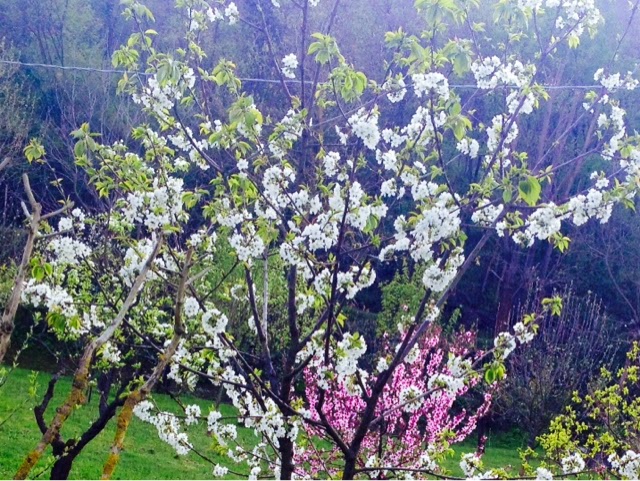
Italian apple blossom

A  flower on a crannied wall
A shrub with white flowers
The sunlight shining through the fresh green of the new leaves
It is a wonderful feeling to be able to walk down a country lane that is few minutes walk from a busy city centre . Yesterday the cuckoo kept us company. Looking at all the fresh green, the shrubs and blossom, even poppies seems to bring out the best in everybody. It was probably on a day like this that Alfred Tennyson wrote this verse while walking along a country lane.

Flower in the crannied wall,
I pluck you out of the crannies,
I hold you here, root and all, in my hand,
Little flower-but if I could understand
What you are, root and all, and all in all,
I should know hat God and man is.
More crannied flowers

An Italian lane in Springtime, just outside the busy city centre

Friday, 28 March 2014

Spring Forward


Pink and white blossom add splashes of colour to the countryside

Wild flowers
This weekend we put the clocks forward an hour and so it will really feel  that Spring has arrived .I love this time of year . There is so much colour in the countryside, big fluffy splashes of white and pink blossom dotted about in the hedgerows and woods, the bright sunlight dappling the grass and the buds slowly unfurling on the trees. Today the air was especially clear and terse and it was a great pleasure to breathe deeply.The sky was beautiful , clear and blue and there was a spectacular sunset. All day long I was aware of the birdsong sounding so happy to be back, and tonight the stars sparkle and twinkle .

 
sun shining through the still bare trees


It is on days like this, when all of Nature seems to be working in such harmony that you feel might have inspired this lovely poem by Robert Browning

The year's at the spring,
And the day's at the morn;
Morning's at seven;
The hillside's dew-pearled;
The lark's on the wing,
the snail's on the thorn;
God's in His heaven-
All's right with the world!


a beautiful sunset at the end of a lovely spring day

Tuesday, 25 March 2014

Ithaka-C.P.Cavathy

Today  we received a beautiful letter through the post. Since the advent of emails it is now known as snail mail but ironically is faster than ever, sometimes letters can take a mere two days from Italy to England compared to the up- to- a month in days of yore. Enclosed in the letter was a copy of "Ithaka" as a wish list . I 'd like to share it because I can think of lots of you who would like it.

Ithaka- C.P.Cavathy

As you set out for Ithaka
Hope your road is a long one,
Full of adventure, full of discovery,
Laistrygonians,Cyclops,
Angry Poseidon- don't be afraid of them,
You'll never find things like that on your way
As long as you keep your thoughts raised high,
As long as a rare excitement
Stirs your spirit and your body.
Laistrygonians,Cyclops,
Wild Poseidon- you won't encounter them
Unless you bring them along inside your soul,
Unless your soul sets them up in front of you.

Hope your road is a long one.
May there be many summer mornings when,
With your pleasure, what joy,
You enter harbours you're seeing for the first time;
May you stop at Phoenician trading stations
To buy fine things,
Mother of pearl and coral, amber and ebony,
Sensual perfume of every kind-
As many sensual perfumes as you can;
And may you visit many Egyptian cities
To learn and go on learning from their scholars.
Keep Ithaka always in your mind.
Arriving there is what you're destined for.
But don't hurry the journey at all.
Better if it lasts for years,
So you're old by the time you reach the island,
Wealthy with all you've gained on the way,
Not expecting Ithaka to make you rich.

Ithaka gave you the marvellous journey,
Without her you wouldn't have set out.
She has nothing left to give you now.
And if you find her poor, Ithaka won't have fooled you.
Wise as you will have become, so full of experience,
You'll have understood by then what these Ithakas mean.

(Translated from the Greek by Edmund Keeley and Philip Sherrard)